
collaborative notes on creating the next meal
February 23, 2025
Make space to eat something delicious that you made yourself. There is a ceremony for this practice. Being at home and sharing food is such a valuable thing. It is superhuman. — Yottam Ottolenghi

I have a dozen or so cookbooks. There are some that I keep purely for sentimental reasons whereas others are on regular rotation. Some are part of my Portuguese Hawaiian heritage passed down from my mom. Then there are the ones, well over twenty years old, that show a velvetine-rabbit-love: torn, stained with ink or rings of coffee, smeared with dried cake batter, drops of maple syrup and olive oil, and pages warped after having to be carefully dried. They’ve made the cut in countless declutters and crossed state lines. Some recipes are even heavily annotated either by me, Jill, my auntie, or Keri. This in particular holds a deep resonant kind of love; where a collection of notes and ingredients become a lineage of memory, shared history, and timestamps. What is life but a series of experiences tied to the meals we have shared.
I know some recipes by heart, but I still reach for the book. It’s a pleasant reminder that cooking need not be precious but honest and familiar and grounded in the ritual of coming together.
It’s a relatively small collection, one I cherish and thoughtfully build. There’s something indispensable about being able to open a physical book. No ads. No scrolling. No pop-ups. The recipe unfolds before my eyes—a tactile, comestible language. If I have a question, need inspiration, or am making pastry dough, I know which book to pull. I may dive into the nuances of technique, explore new spice combinations , or research variables like temperature or humidity. Sometimes I just love reading the stories of how people experience the world and relationships through food.
To prepare a meal is a humble collaboration of objects and actions, from which a kind of magic unfolds—a list of ingredients linked to a process which is interpreted by a cook in order to make the next meal. I like how Etel Adnan, in The Beauty of Light Interviews, puts it.
So, I didn’t start painting with a brush. The brush came later for drawing. I really began with this knife, and it has remained my instrument. The tool you use directs what you do considerably. There is a collaboration between the objects you use, and this is true beyond painting. It’s true in cooking, it’s true with clothes: if you have silk fabric, you’re going to make a different dress than if your fabric is linen…I’m very sensitive to the role of objects in our lives, to the importance of this collaboration.
The longer you grow a garden and observe a plant over the course of a year you recognize the slightest change in detail, pattern, or vitality. The changes in the wind, the quality of the sun, or the first sign of bud break are all, in a silent way, phrases in the language of landscape.
Cooking, like gardening, is also a sensing art of tuning the dial. A cook's book may reveal a lifetime of dialogue, great dish-make again-cook for an additional 10, maybe add lemon. It’s an object worn by time, a repository of recipes, full of scribbles. It is a disservice if the book collects dust, purchased (like many things) only to fulfill a fantasy self or life. What has been written can become quite personal, eventually shared, passed down, held in secrecy, or adapted personal.
By living we learn
Becoming a good cook is about consistency. But probably the most important thing is generosity. You have to be willing to fudge it all and unconditionally share. I both teach and am taught. Being interested, curious, and passionate also helps. And love has to be there, somewhere. I don’t think it’s possible to become excellent at something you despise.
I personally gravitate towards the kitchen. It’s a comfortable space, be it cleaning, cooking, prepping, washing, or watching. I have always loved food and I discovered early on that participating filled me with immense joy.
The folks who inspired and taught me how to cook didn’t have exorbitant cookbook collections or reference libraries. They may have been widely published or available in the seventies and eighties but were not in my orbit. If I was interested in making something, I’d ask for help, experiment, watch first and then try it out myself, or pull down the one cookbook I remember my parents had, The Joy of Cooking. I grew up where the home was a hub and at the center of that hub was an active productive kitchen. Home cooking was the norm, not a novelty, and I wanted to be a part of it. As I grew up I surrounded myself with a strong and innovative food culture.
I’m not against cookbooks. I’m all for record keeping and documenting our food stories so that they may be shared. My comfort and ability to experiment came from the kind of intimacy only books can provide. However, cooking is alive and dynamic. It’s more than following a list of instructions, it's our humanity. It was only when I stood shoulder to shoulder with others in the kitchen, observed from the table, and asked a ton of questions that the next meal began to make sense and take shape. I’ve come to know that it’s about exposure, experimentation, play, error, embellishment, editing, and sharing.
Collaborative Objects
Cookbooks like many living traditions arose out of a desire to share in order to remember time, place, migration, and culture. As a result, it needed to be recorded, out of altruism and out of collective healing. Recipes are sensory time capsules which become tools for those who’ve forgotten or want to learn.
Today’s cookbook is an interesting blend. Memoir meets architectural digest. Ethnographer meets steaming bowls of broth. With a growing emphasis on photography it ends up competing with the likes of a Phaidon design anthology destined for the coffee table. It says, I can love and appreciate food without even having to cook. Unfortunately what a staged table, a pretty dutch oven full of beans, or the perfect apple crumble fail to capture is how cooking is both ephemeral and ruthless. Nor does it capture the potential satisfaction of cooking or the multifaceted sparks of insight that inform human hands. It takes forethought, prep, experimentation, time, patience, a lot of pots and pans and a hard working stove.
It was from an interview years ago that I heard Ottolenghi say, make space in your life for the ceremony of food. I believe this to be true and more important than ever. My kitchen is that place. I don’t care for a ton of extraneous stuff. I’m quite neat and organized. It calms my mind. My counter tops are bare—ready for the next project. The essence and charisma come from the freshness of the ingredients, my hands, and my approach. It’s a crescendo of animation—a nice flow. Today it’s mixed vegetable and white bean soup with farro. Unfortunately the sourdough boule won’t be ready till tomorrow.
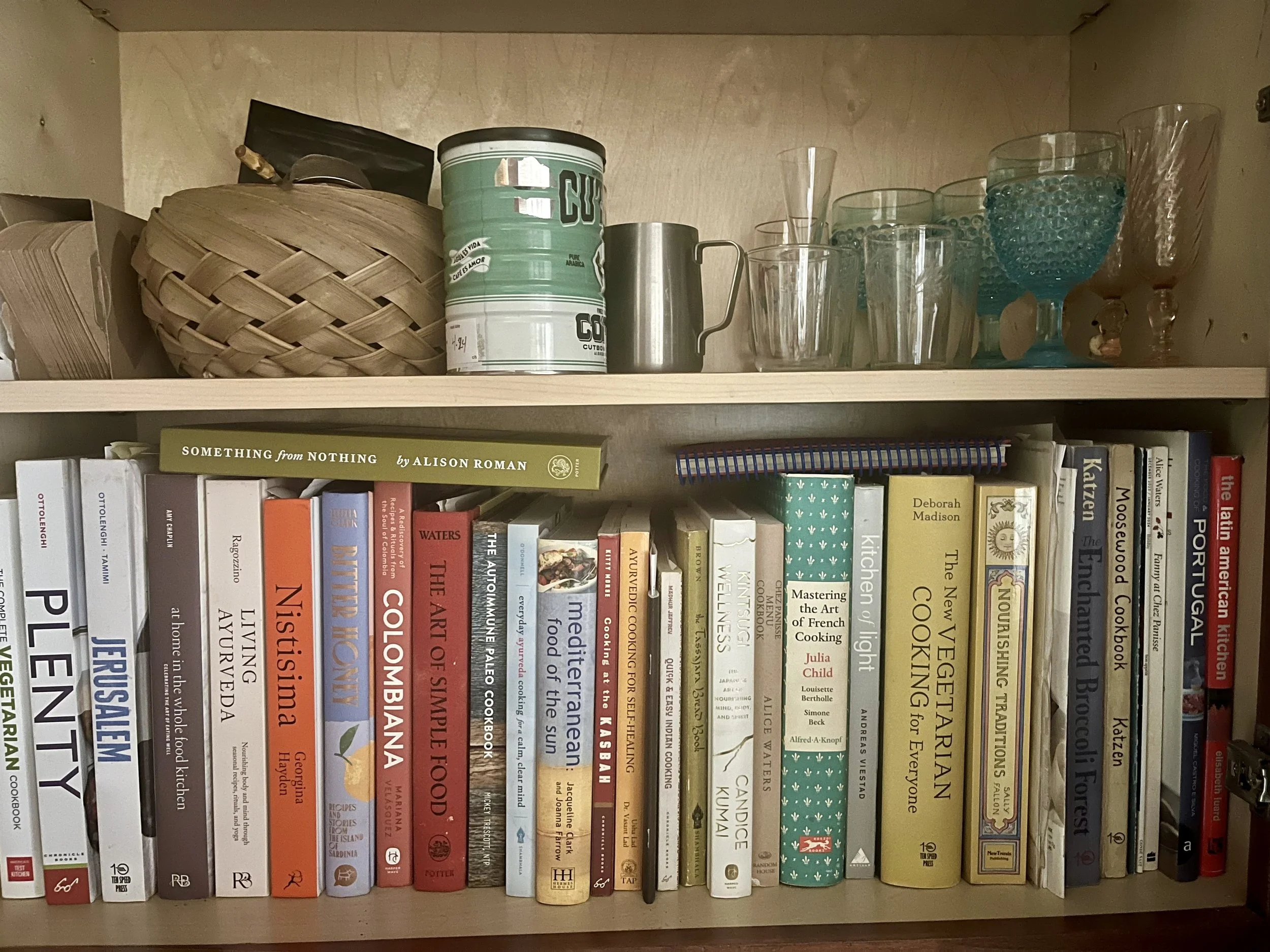
current collection on a kitchen shelf
Soup, or some version of it, is intuitive. It lives in my mind. I have no set recipe, only the tone or mood. At some point I might document them all. Catalog and wrap them up in a leather portfolio or paper box. My mom had a little plastic one. I can still recall the two vegetable salads she’d love to make. Delicious. My dad, the engineer, had a binder. A phenomenal well-tracked and documented timeline of marinades and barbecues, temperatures and weather conditions. All of which is part of the story. Box, binder, or brain…the method of how it’s housed varies, but the collection is indeed a collaboration of stories, friendship, landscapes, atmosphere, diaspora, song, prayers, a toast…..
I am particularly nostalgic for the old pencil boxes, the epitome of my elementary school experience. I cherished my little box that, over time, became an embossed, tagged symbol of my creativity. Currently I have a plastic sleeve meant for a binder and this little notebook. I have recipes that are printed, handwritten, ripped from magazines, or on the back of vintage postcards. It is my inimitable and beloved history. Beautiful and functional. I’ve finally started to bring the notebook when traveling just for food ideas. I note all of it—the fundamentals, how it was prepared, the spices, notes on a sauce or broth, texture or consistency. Then when I return home I play around and express it in my own particular way.
This may seem antiquated and certainly less glamorous than the polished hard bound books in circulation, yet I do love it. It’s quite intimate—the evidence of how the next meal is made. It’s a codex that captures taste and flavor, nourishment and relevance, plates and memories of communion. In an emergency I will grab this.
Yours, Erin