
Innate intelligence-changing perspective and physical location
Discovering ‘places to be’
October 13, 2024
Some of the most robust and resilient plants in the garden are the ones that find their own place. The seed settles in, the conditions are favorable, and at some point in time when conditions are optimal, the plant grows. And not only does it grow well, it often thrives.
I’ll happen upon them by chance when out wandering or watering. It’s always a pleasant surprise. Ah ha, so here you are. That’s the spot you like, alrighty then….I say to myself. I let them be. I may have planted a close cousin or a similar variety a distance away or even the previous year. It may be faring well or it may not. I always find this multiplication and propagation of plants fascinating – a window into their intelligence. Regardless of the scenario, I happily integrate them into my naturalistic planning scheme. I consider it not like hide-and-seek, but some other game of reveal. The kind of game nature, and in this case my garden, continues to play with me.
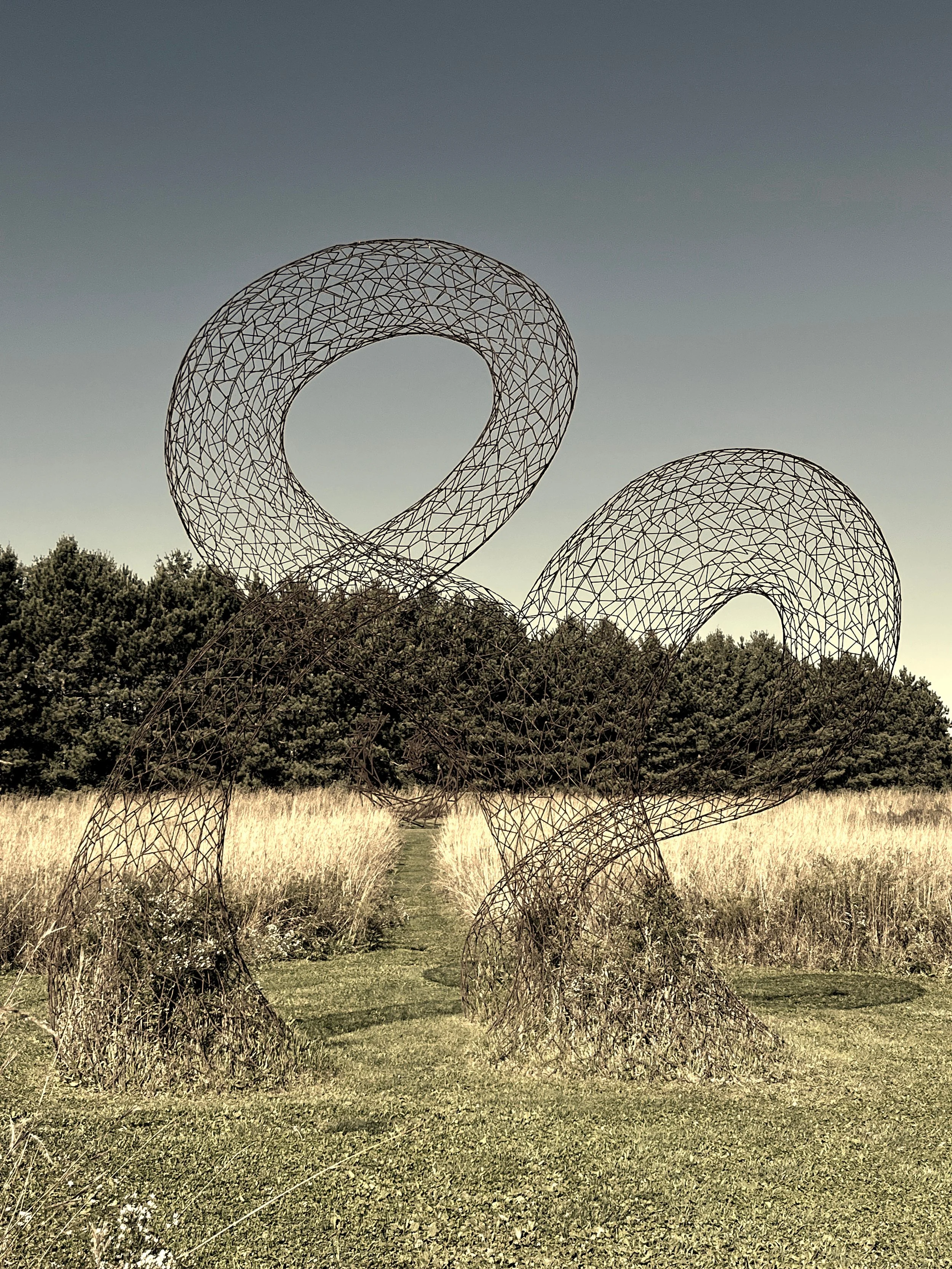
photo © Erin Johnson - Tendrils by William Lanzillo, Franconia Sculpture Park
I call it the ‘places to be’. There’s another aspect to this game where I’m more involved. And I take the initiative. This is when I notice that a plant is not in the best place. Often it’s struggling in some way or another. This has come after years of devoted engagement, practice, triumphs, and mistakes. In other words, time. I thereby, knowing what I know about that particular place, the conversation of the surroundings, the soil, the light, or the shadow, actively seek out a different location for it to live. The red-twigged dogwood, a ‘Pinky Winky’ hydrangea, a provence lavender varietal, the raspberries, and a few columbines I know are ready to emigrate. Either they haven't dug the place I planted them or I want them in a different location based on my ever evolving garden design.
Now there are two strategic times one can uproot, transplant, and relocate in the garden – either the autumn or the spring.* Timing it in the fall can be a little tricky. It’s important to ensure that the plant has a few weeks to regroup after the stress of transplanting. A good four to five weeks before the first hard frost is best. There will still be ambient warmth in the ground from summer and the evenings are cool, so it works out nicely. You just don’t want the roots freezing before it settles in. If I move any of these plants it will be in the next 2 weeks of October. If I’m unable to get to it, I’ll wait until early spring, like March, which on the flip side is also a good time. This is when many of the plants literally begin to wake up, showing new shoots and swollen buds. The roots, really their entire being, having laid dormant for a few months are primed and ready for growth.
Part of the ‘places to be’ move involves taking in what already exists in the surroundings and how I’d like to accommodate, adapt, or amplify the space. Where do I want to wander? Does the pathway need to be rerouted? Do I want those textures to mix and layer? The game of ‘places to be’ is as much for the plants as it is for me. ‘Places to be’ are not merely physical geolocations but perspectives which are born from time and place. This may be a particular view, a selection of specific plants, where I’d like to sit and spend time or what I’d like to look at. Sometimes it’s even about creating a place that takes advantage of somewhere else, even though the two places aren’t actually connected. Like how a swing or bench under a tree provides the place to look at a far away vista, a striking tree line, or a tangle of flowers.
‘Places to be’ are often very simple little devices to incorporate in a design and worth spending time considering where they end up and as a result where some plants are best settled.
Where you feel most comfortable
Where the sun falls
Where the shelter is
Where your eye wants to fall and rest
Where you can encourage your eye to travel, move and explore while finding the places and the ways those views can be channeled
There are variables to consider, many of which are influenced by how the sun hits and where the shadows fall on a February morning versus an August afternoon. It calls upon our humanness, an innate awareness and understanding of circadian beats, observing time and season, quality and mood. Sensing and tuning into these variables, the language of nature, is far more accurate and telling that any date on a calendar.
I’ll share something that illustrates this concept by how I’ve arranged the inside of my home. I find that the same sensing of places to be goes for interior design as well. Ihave a small sofa in my living room which faces due east. I’ve set it as such so while I drink my morning coffee I can relish the morning sunrise through a large picture window. The light streams in and illuminates the entire area. I’m able to watch the birds, the grapevine, etc. It’s not so much where the sofa is in space, rather how it relates to everything else, including myself.
I’m always thinking how I can hone in on a particular view, clearing a path for the eyes. I love to just sit and think. A chair here, perhaps a bench there so I can look out to the northwest, as it’s open and unobstructed. I like to be under the western redbud in the spring when it’s in full bloom or in the narrow garden path mid September when the vegetation makes it barely visible. I may even crawl behind my cats as their vantage and way of navigating allures me. It’s quite a different perspective.
What I love most about these ‘places to be’ is that they can be anywhere. Whether created or discovered, there is no hard stop, no end in sight, rather a cyclical undulation of an ever transforming life. Where are the ‘places to be’ or where may they best be found? Well that’s the game…and one that I contemplate as I walk around the garden. I never have it exactly mapped out but I do sense when a shift is in order. I have a good idea where I’m going to relocate the plants this coming spring. Truth be told, the lavender still eludes me. I’ve yet to find its place nor has it told me.
Yours, Erin
*for locations where there’s a significant hard frost and a deep dormant winter. In mild, more temperate climates this is not as applicable.
Announcements and Updates
Since I’m on the topic of ‘places to be’ I’ve made a recent change to INTUITIVE ARRANGEMENTS-Flower Arranging 101.
It combines videos, guides, and even a short intentional audio meditation for you to expand your senses, hone your style, and connect to the elements behind the blooms. Check it out if your into experimenting with perspectives and plants.
It’s now a 5-day email series.
It’s still self-paced. It’s still something you will always have once you purchase it. It’s still for flower lovers and covers basic mechanics and botanical design.