
Syntropic Farming Part I — Looking to forest ecology to heal the economy
September 21, 2025
And changing the narrative of abundance
Nature is one of our greatest healers. There is healing in the wind, the sun, the moon, the stars, the ocean, the stones, the songs of the birds and the flowers. It is only for us to trust this is so and allow ourselves to receive. - Linda Kaholokai
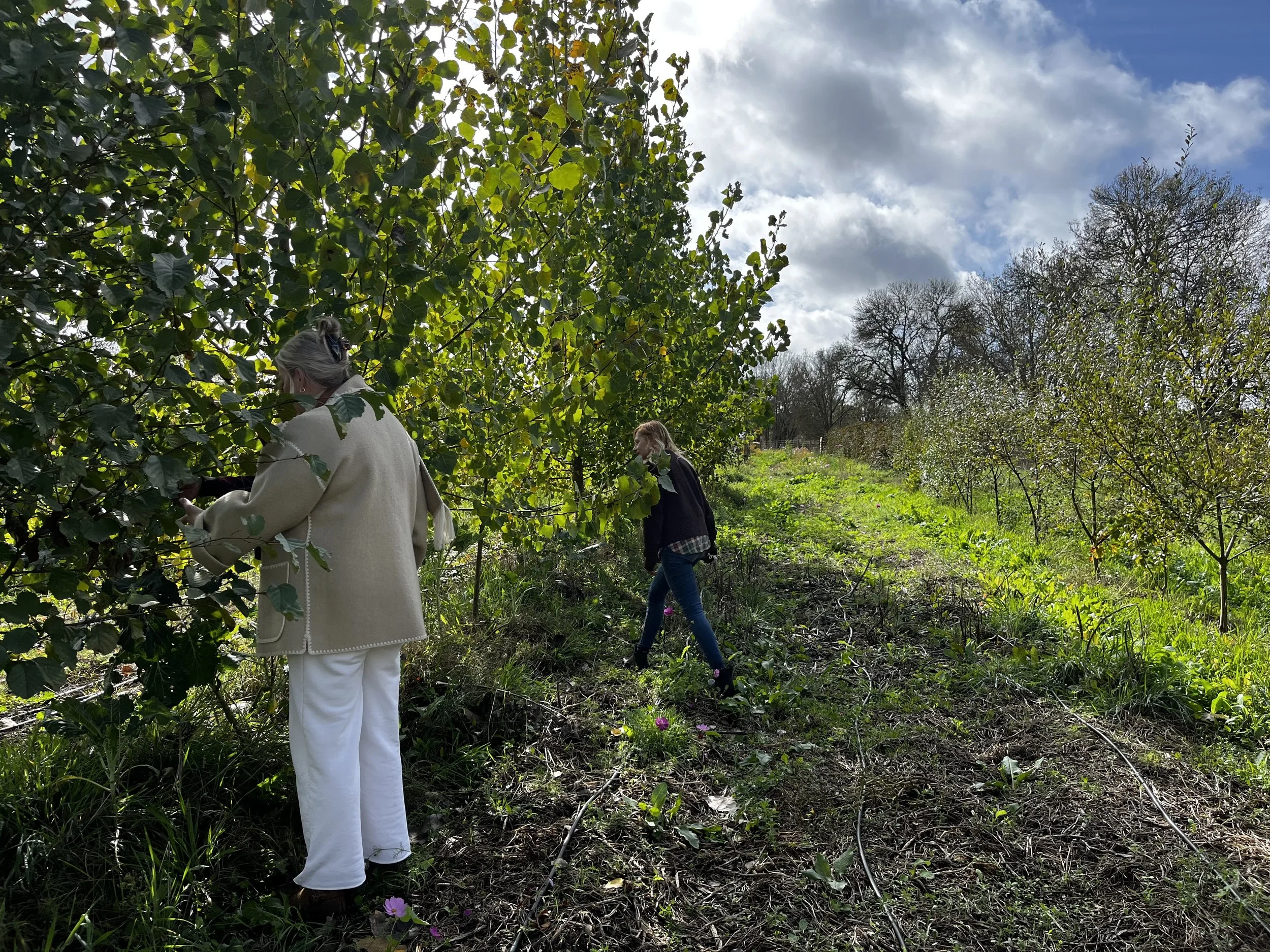
photo©Erin Johnson hedgerows at herdade no tempo, Alentejo Portugal
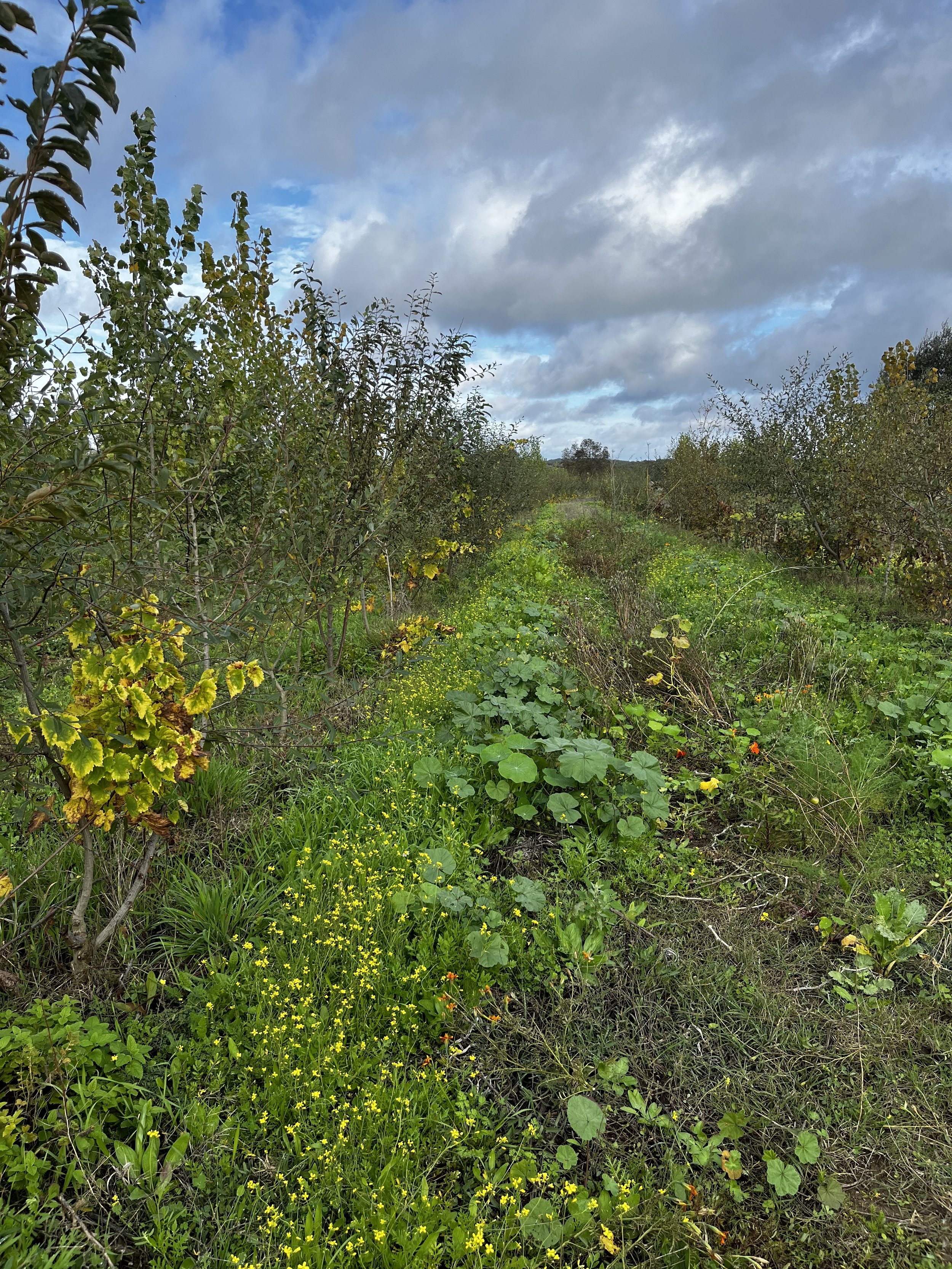
photo©Erin Johnson beautiful autumn days at herdade no tempo, Alentejo Portugal
A few months prior to graduating college I started working on a small organic farm in the coastal mountains southwest of Eugene, OR. And though it made getting through late afternoon, dimly lit art history classes of Persian architecture or Mongolian metal work difficult, the fatigue was worth it. For the next five years, prior to relocating to New Mexico I worked on farms, grew my own gardens, wild-crafted riparian grasses and herbs, canned jams, cordials, made wine, you name it.
The organic, permaculture scene in the Willamette Valley was vibrant and I was thrilled to be a part of it. Yet most of the farms I worked on were, in essence, market farms. Some were CSA farms (community supported agriculture), but most pushed themselves to sell as much as possible at the Tuesday and Saturday markets or direct to restaurants. The beds were long, in some cases the length of a football field, full of broccoli, potatoes, salad greens, kale, squash, melons, beets. It was a business. And a hard one.
As farms go they all were relatively small. Anywhere from 4 to 15 acres. One in particular had the most divine cherry orchard. Spring was magical. Another a hazelnut orchard that also specialized in fancy salad mix. Yes, even then, twenty-five years ago, it was a big thing.
From that point on I've never not tended a garden. Nor can I imagine my foreseeable future without its presence. It has become a part of my home, lifestyle, ethos, and family. I orbit it. I embodied what I learned in Oregon and then transported it here to Albuquerque.
Now, if anyone knows these two bio regions, they couldn’t be more different. Even though Albuquerque itself is pretty diverse, ranging from the cottonwood Rio Grande valley to the 6,000’ rocky escarpments of the Sandia foothills, it’s a different place entirely.
However, even though it's arid, hot, and extreme there are commonalities. For starters, you can grow a lot of the same kind of produce (whether I should, is a question and conversation for another essay). I’m able to do this by tuning into the nuance and seasonality of this place. There are micro climates within micro climates. I also adopted a lot of the same kind of processes: dependency on outside inputs like mulch, manure, water, fertilizers, and compost (I make my own but not enough).
After learning about Syntropic farming and the methods that are employed in the arid southern regions of Portugal, I now know my approach has to adapt. It must. I’ve become a little too fixed in my ways. And consumed by a very limited definition of wealth, health and abundance.
Luckily before any transformative act, the belief or assumption that precedes it must shift. Transforming the landscape and having it be wildly productive is possible as projects like Gaviotas, Masanobu Fukuoka’s One Straw Revolution, and now this has shown.
To recognize love as a force much bigger than us—a force of nature. Willow Defebaugh, Editor-in-Chief Atmos
Syntropic farming is an approach; a way of farming that simulates what a forest ecosystem does and replicates it in a food production mode. The very architecture of this method embraces an entirely different world view on systems economics. But to this I must note: only different when compared to modern, commercial, money driven structures where a binary agreement of profit and loss trumps everything else.
Listening to fellow farmer, António Coelho from Terra Sintrópica talk about the land and what they’ve created was truly inspirational. Probably the most impactful perspective he shared was on wealth and economy. In a culture where we have a terribly backward relationship with, it was a potent, revolutionary reminder. The questions he answered, and I’m paraphrasing, was how does this farm remain competitive? Is it efficient at all? And how is syntropic farming profitable compared to large-scale monocrop farming?
We need to understand that this concept of economics is wrong. When we just see the money side of it, we don't or are not considering the degradation that is implicit there, the water scarcity that is created, the social problems that are created. We are removing all these variables from this equation to then consider that this model is more economically viable than the others. I think we need to be a little bit more realistic and enter different variables in order to understand what's the most valuable and available ecosystem you work with. I’d say that this [agroforestry] ecosystem is more productive in all ways.*
There have been plenty of times I’ve lost sight of the other variables. Falling ill to the economic engine of greed. In contrast, having a lush, layered landscape to be in and tend to holds value. So does saving seed or propagated plants to disperse and share. Co-creating a highly diverse habitat for a world of creatures is healing. And as a result, this property and then subsequently this neighborhood becomes a more beautiful place to inhabit. It’s the epitome of abundance.
I’m grateful for the reminder to question the legitimacy of an apocryphal economy based on profit alone. Though it can be terribly uncomfortable to rip away from the status quo, it’s often worth regular examination. For there’s much more to understand and honor. The health of the soil and water, our food sovereignty and systems, and community integrity should not be reduced to dollars. Zadie Smith, in her essay, “The American Exception”, cuts through the rubbish, making it clear as day to demand an alternative from money’s grip. Or if nothing else, be aware of its existence.
Not that there is anything ridiculous about trying to lengthen the distance between the dates on our birth certificates and the ones on our tombstones: ethical life depends on the meaningless of that effort. But perhaps nowhere in the world has this effort—and its relative success—been linked so emphatically to money as it is in America.**
An approach—all flourishing is mutual
This approach to farming is not new, perhaps novel, but not new. Contingent on a constellation of variables, succession and layering, super dense plantings, diversity, and stewardship, it’s an approach that’s redefining the meaning of economy, competition, and connection. Not that I needed an excuse to continue gardening, but how I was approaching it was due for a shift. And I’m embracing it full on.
On economy — It can be dangerous when money or profit is the only variable for economic viability. It’s a limitation. At its worst, greed. Our relationship with family, community, water, soil, wellness, food, music, art, dance, etc.….are essential for economic abundance. There is a steady decline on the dependency for outside inputs as bio density and diversity improves.
On competition — For example, in my garden this year the plants that were super dense and diversely planted were the healthiest, strongest, and most resilient. Yes I want to keep the weeds out, but I encouraged the volunteers from last year to come up in the mix. What I assumed was always a competition—vying for water, light, nutrients, air flow, isn’t really an issue. The opposite is true. They figure it out and support each other in a subterranean and terrestrial symbiosis of interlacing roots and surges of hormonal growth.
On connection — Connection is an overlap of layering or interleaving. In agroforestry, one of the benefits of dense layered planting is the self-generation of biomass from which one can ‘chop-and-drop’ (when pruning or cutting back with chop up whatever it is into smaller pieces and let it fall). This assists in the acceleration of healthy soil, surface humidity, microorganisms, and an overall interdependent network ecology.
Every so often I feel as though nature, the landscape, or reality itself is patiently reminding me to take the hint, receive, be a part of (not in control) a much larger system, and follow its lead. Now happens to be one of those times.
Yours, Erin
Resources:
*Farming Like a Forest: The Syntropic Revolution in Southern Portugal
**Zadie Smith, Intimations (New York: Penguin Books, 2020) 13.
The essay first appeared in The New Yorker, April 10, 2020, but now is nestled in Intimations, a collection of essays emboldened by an upwelling of emotions in the early days of global lock down.
More details and stories at https://terrasintropica.com/en/