
The kindest thing you can do for yourself
On exodus and re-entry
May 10, 2026
In response to April 12th's essay Where is the precious wildness we seek, I received the following in reply. It’s one line pulled out of a longer note, but it captures it all. And something I’d like to talk about. (shared with permission from one of my dearest friends and readers.)
“I got to say that I don’t know how the f#%k to make life go slower. I want it from every cell of my body, I want it so bad.”
Oh my heart. Why is it that the how seems so elusive when we know in our heart of heart what we must do? I know you are not alone. I’m right there with you. I see you. Life has its own sequencing and moves in so many directions. Much of which, I might add, is inconceivable to our sense of time.
Context is everything. Though we all live in concert with others, our cadence is our own. And so is the ability to adjust the aperture. How much light do we let in and when? When is it time to ask for help or to surrender to what we cannot control and bask in the reverb of new kind of freedom.
You already know this. But it’s worth repeating. What we bring our attention to expands. And wherever our attention goes, spirit or life force follows. It rides our attention like a wave. There are a few things that have really helped me along the way. Some quite mundane others a bit more esoteric. All of them ultimately service. And I want to share them with you. Think of them as points of access. Ways in for slowness to seed and take root. Even if it’s one percent or five minutes here and there, participate with all your attention. And it will grow.
The following practices have radically helped me transform how I live.
Chewing at mealtime
When it’s time to eat, set yourself a place as if you were hosting a beloved. Between each bite, put your utensil down and chew. Chew and breathe. Breathe and chew. This is it. This is the magic. Your saliva will kick in and hopefully an explosion of taste will follow. You’ll get a good gauge as to whether or not you're stuffed up. This practice, as straightforward as it is, has an utterly profound way of supporting your overall digestion. And not just food, but life as a whole.
Erin O’Connor in her interview on living slow, shared something I want you to hear. “Slowing down doesn’t mean literally slowing down to me, but attuning my actions to my needs.”
This is exactly what chewing thoroughly allows for. Attuning your actions to your needs while expanding your sensorial capacity. Or stated another way, nourishing your soul while engaging in something biologically useful.
Multi-task reckoning
Ditch multi-tasking which coincidentally relates to the first. Chew, breathe, experience, and observe the meal. Enjoy it with whomever you happen to be sharing it with, if you are. But honor the time by doing just that.
Now with this one, I want to add a little color. For example, I sometimes love going on a walk and listening to a podcast or dictating notes for an essay into my Notes app. Look at me! I’m doing two things at once. I’m researching a topic for an essay while in the great outdoors. Or I’m listening to Brian Eno’s Music for Airports while I write. But here’s the thing, I can only handle certain combinations of sensory input. If an action needs my undivided attention I keep the other chill. And visa versa. For example I can’t read a book or write an essay while listening to a podcast. Too distracting. Too much vying for my attention.
The reason why I’m bringing this up is because there are many times when listening to your body, the wind, the birds, etc. and nothing else is the practice. It’s not silence. It’s your surroundings. It’s your body rewiring. And that’s important. However we all have a saturation point and hopefully you can give yourself the space to see it coming or know when it’s arrived and pivot.
Multi-tasking, as socially rewarded as it is, unfortunately amounts to going overboard on information consumption. When we're constantly in intake mode there’s no bandwidth to do much else. It’s tricky. At its worst, it is debilitating. If you feel saturated, going on a walk and listening to the leaves, birds, your own footsteps, or the white noise of traffic can be a radical act of presence and personal preservation.
How do we become practiced at following our heart, trusting our intuition?
I often go back and reread the book Mary Magdalene Revealed by Meggan Watterson. Last night this one line stood out. The word death in Aramaic, the language Christ spoke, means existing elsewhere. It got me thinking how true this is, maybe not in the literal sense but figuratively and energetically.
I may feel paralyzed by the horrors of recent news. Or like I’m a stranger to my partner. Sometimes I lose my ties to the practices that keep me balanced. I’ll lack the energy or inspiration to call a friend or cook dinner. Remember, if our bandwidth is gone, we aren’t or can’t be present for whatever the circumstances may be. What I think can end up happening is an accumulation of micro-deaths. String enough of these together and life may end up feeling like a discombobulated, disconnected frenzy. Instead of being here, present (attuned in mind and spirit), we are elsewhere.
Ram Dass would say, as it pertained to relationships and this life, we’re all just walking each other home. But in some cases, we have to remember to walk ourselves home too.
May the love for yourself be so fierce that there’s no other choice than to dive in. The water will slow you down. And the splash will ripple outward. Trust. Simple. Magic.
If you’ve made it this far, I have one more thing to share. This short, one minute clip of a poem from Andrea Gibson. It’s so good. And touches on exactly what we’re talking about!
Never Wait to Live - a poem by Andrea Gibson
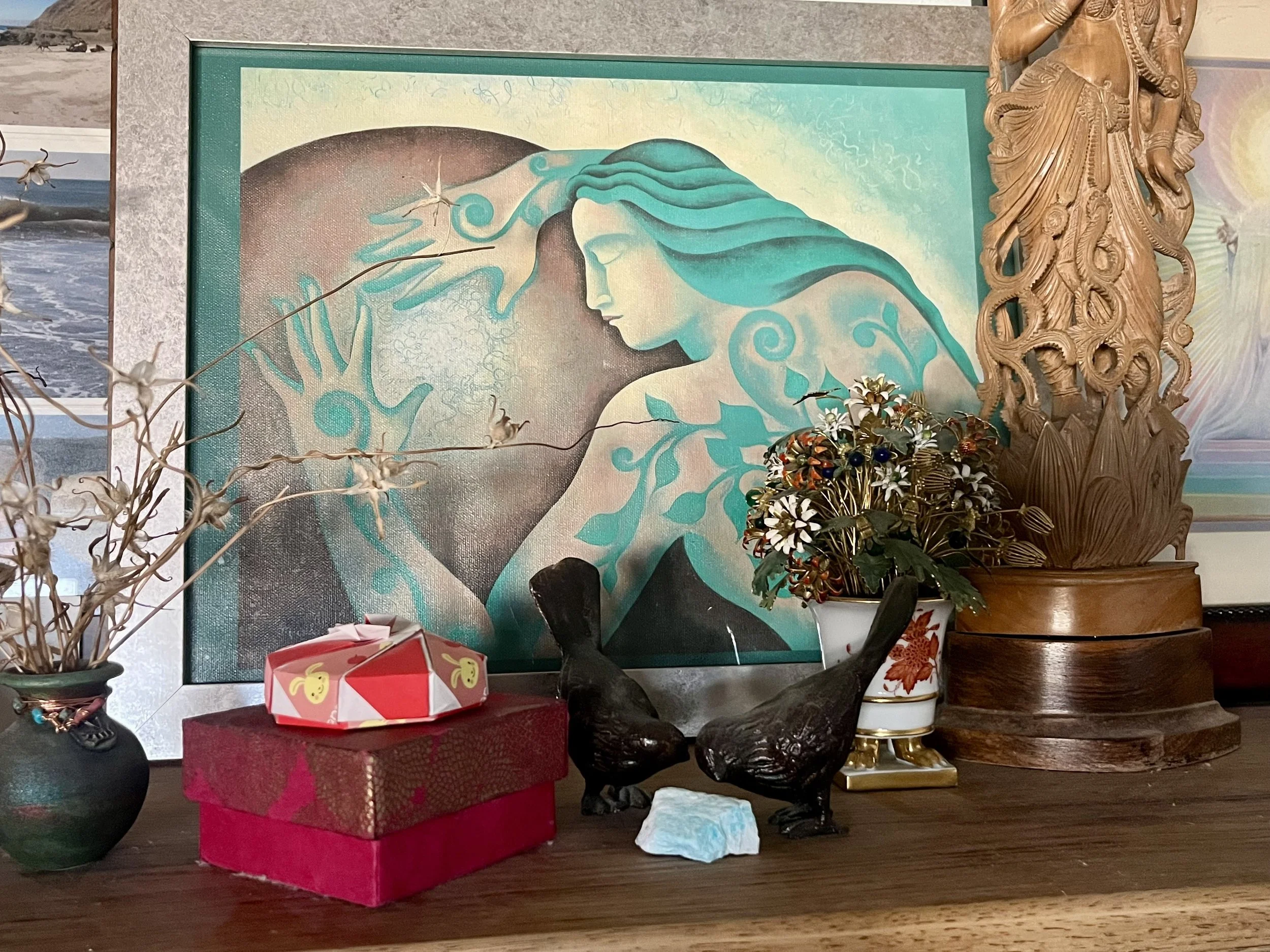
mementos on my bookshelf, glicée by dear friend Mara Friedman