
Open Yourself with Erin O'Connor
[Series] On Slow Living #4
November 24, 2024
Erin and I met in our early twenties at a small dinner party in Udaipur, India. I was there studying and writing a paper on the making of terracotta deity tiles, a vernacular art form being produced for small shrines in the surrounding villages. The project culminated my time in Rajasthan—four saturated months in arts, culture, and language. It was vibrant and life-changing. Erin was working at a Nonprofit whose mission supported local women textile artisans in weaving and handicraft. Drawn to one another the moment we started talking, we became friends and spent as much time as we could together while living there.
Over twenty years later and still very much involved in the creative arts scenes, we remain in touch. And though it’s been a long time since we’ve seen each other in person, we adore each other from afar. I think the last time we saw one another was when I still lived in Oregon.
Erin’s an author, professor, ethnographer, and artist. Her ideas and perspectives are always illuminating and inspiring. Aside from all the cool things she creates, teaches, and writes about – her most recent passion and publication project orbits the art of glassblowing, which has taken her to the thriving studios of Venice, Italy.
In an opinion piece for HYPERALLERGIC, Erin riffs on the interconnection of art, land, supply chain, and systems processing. What goes on beneath the surface, which we often don’t see, in no way means it should be ignored.
“The mineral metabolism of life in Spruce Pine is tangible: silver on silver, sparkle on sparkle, salt on salt, mineral on mineral. The geological is not simply a condition of human life; the geological is human life. Art worlds are mining worlds….There are orders to be filled and stuff to be made. But so too does it compel those of us in various art worlds to understand ourselves and the ongoing formation of the earth as two sides of one and the same creative process — to interweave the human experience of self-determination with that of the living, and dying, ecological world.”
I don’t know many Erins but coincidentally the three I do are some of the most rad, amazing people I know. I love her so much and am overjoyed to share her thoughts with you.
Thanks Erin.
Yours, Erin
What does slow living mean to you?
I think it has nothing to do with time. You know, like actually going slower. I remember once an acupuncturist was like, ‘You need to relax.’ I’ve seen him for like 20 years. He’s like, ‘You gotta relax. Slow down.’ I was like, ‘What if I’m a rabbit? Would you tell a rabbit to relax? Would you tell a rabbit to go slower?’ I happen to be a rabbit in the zodiac. I think people have to go at the speed at which they are born, right? So slowing down doesn’t mean literally slowing down to me, but attuning my actions to my needs.
For me, I love attending to materials, life’s pleasures, textures, food, cloth, the air, waters…anything visceral —love, bodies, lovers, books, words. All of these things have a corporeal element to them. My children, their hair, baths, showers. As somebody who goes quickly, I think slow living means tending to those things along the way. It doesn’t literally mean slowing down. It’s more of a relation to what I do. When I’m attuned with the world, with what’s flowing in and out of me, I have a sense of slow time.
What's one thing (action, mindset, ritual, habit, etc.) that's essential to maintaining it in your day to day life?
I have a very pragmatic answer for this. I wake up with the sunrise every day. Typically 5 o’clock is when my alarm goes off. My kids have been getting up earlier, so I’m thinking of pushing it to 4:30. For me, it’s really important to be awake with the sunrise. This is when I do my writing. This is when I read. This is when I do my editing. This is when I have my deep thoughts. My children aren’t awake, the world is silent, and I can think.
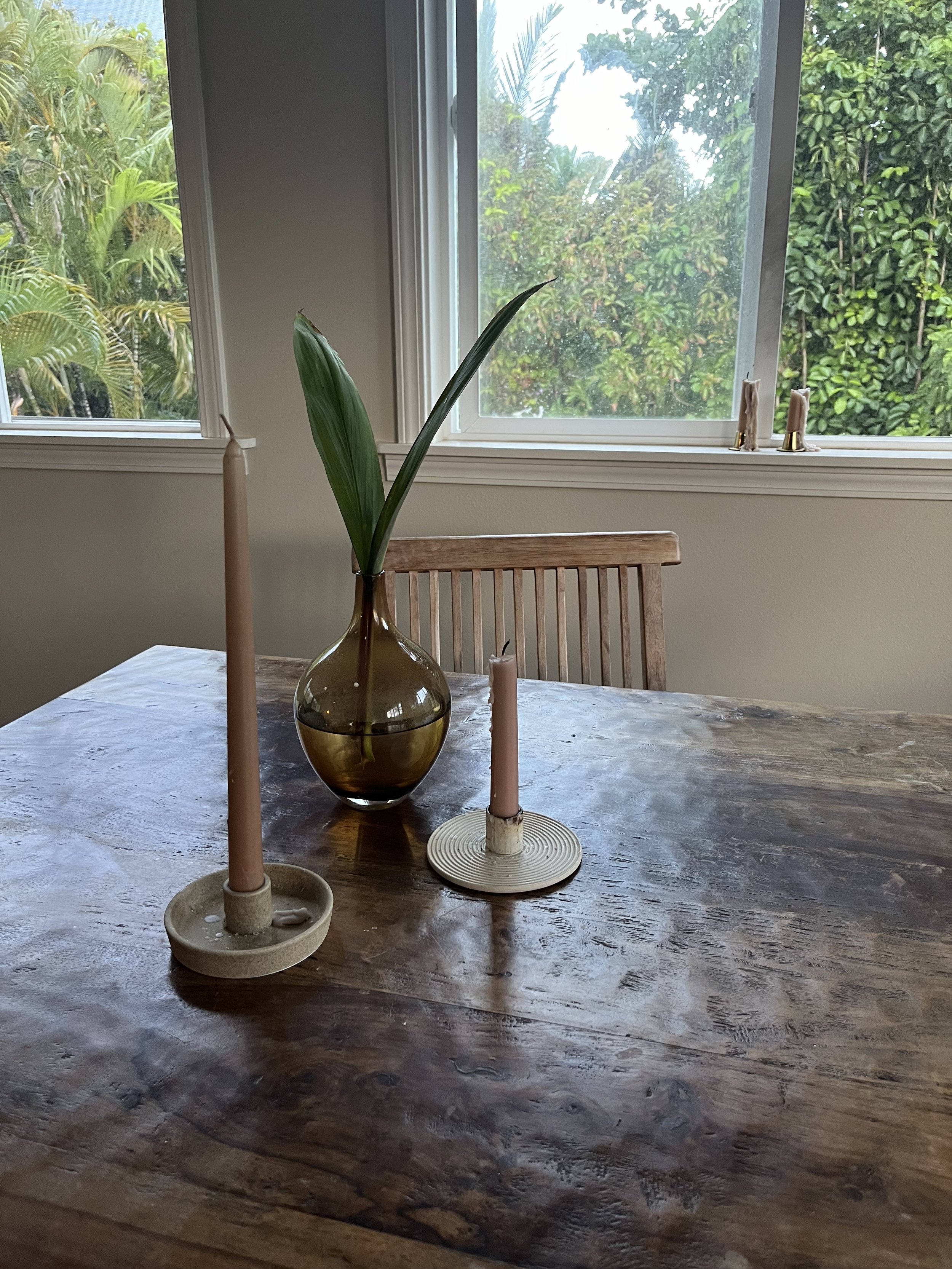
Some days I don’t want to do it. First, I have to prepare lunches and snacks. Then, I make my Irish breakfast tea and read. Then, I make my espresso and sit to write or edit by 6 o’clock. I allow myself permission just to go through those movements. Some days, I don’t want to do it; some mornings, I’m psyched. But it’s a ritual, and the outcome is typically always good. I love my tea. I love my coffee. I light my candles in the dark season. The hug of morning darkness is important to me. It feels good. When bright Venus is high in the morning sky in the winter, it especially reminds me that I belong to the universe. As does the day ahead.
I listen to music at various points. Something that’s totally awesome like Minnie Riperton’s song about les fleurs, the flowers; she reminds listeners of the beauty of the world and that everybody is a flower blooming. Or the disco queen, Sylvester’s everybody is a star. Or any of Patrick Cowley’s intergalactic songs. Songs that remind me that I am a body with blood pulsing and it’s wonderful to be alive. It doesn’t always work, but that’s my ritual. I’ve been doing it for over ten years.
How do you ensure that a little bit of wildness and or nature remains close?
This is not a direct answer for me. I live on New York City’s East River, for example. Part of my reason for moving from my old place in East New York to Midtown East was because being close to the water was important to me. I grew up on Lake Huron and even though the East River is polluted (though it’s getting better with the oyster project, etc.) – it puts me in touch with water and that sensory experience. I talk to the seagulls. I feel the breeze. I watch the currents change (it’s an estuary), and the ships coming and going. You can smell the brine that comes all the way up from Jamaica Bay. What I mean to say is that I don’t think that the wild and nature belong to something idyllic or pristine.
My great-grandfather was a painter from Detroit. He was a magic realist. He once talked about the weeds in the sidewalks of Detroit. He explained that while he mostly painted still lifes of garden flowers, he also found beauty in that often overlooked, like the weeds. I one hundred percent agree with him. In fact, in environmental studies, some thinkers argue that the idea of “wilderness” arose as a counterpoint to industrialized capitalism and contributes to today’s environmental problems. If nature is always with us – no matter where we are, city or county – and not ‘out there,’ then we can’t avoid responsibility.
So I think wildness is anywhere that you have eyes to see it, ears to hear it, a mouth to taste it, or a body to feel it. And you just have to open yourself.
I’m a big reader of Simone Weil. I don’t agree with her on many points, but I do agree on the practice of waiting. The idea is that we have to “do the work,” but that, ultimately we have to wait for what we’re striving towards. The work prepares us to receive what is coming. So, we work, go forward, go forward, go forward, push, and work at the tempo that suits us. But, at the end of the day, we’re waiters – not like the restaurant type, though I was that too for many years. This method hasn’t failed me. Eventually, through a lot of work, my eyes, ears, mind, body, etc. will eventually open to what I was looking for. But, you can’t see it or know it until you see it and know it.
So you have to go on the walk, you have to get up at five, you have to write. And then you have to be open to gifts that come from the world, that meet that work halfway so to speak. So I do that. I go to Central Park. I love it there. But nature is everywhere. It’s not outside of me – in a park over there. It’s inside of me as well. It’s not something that I have to go into. It’s part of me. You just have to be open to it. For me, this dynamic has a disco vibe. Nothing short of it. I don’t see disco as being at odds with the East River, Central Park, the wind, or the weeds in the sidewalk. If I were to put a soundtrack to nature - and my blood coursing through and with it – disco would likely be it. It’d be the good stuff that I mentioned earlier, Sylvester, Patrick Cowley, Donna Summer. I can live without the Bee Gees! I find joy in finding joy and tapping into the jugular of life.
I hope that’s helpful. And of course I love natural nature kind of things too – my gardens and time I spend in the beautiful Berkshire mountains. There, I talk to the owls and eagles, the meadows of milkweed, and can feel the cradle of the regions valley. But this experience is everywhere…it can be found.
Thanks Erin,
Yours Erin