
It is time to become immense
February 15, 2026
The sensuality of cyclical consciousness
It is time to become immense.
To become immense means to recall how embedded we are in an animate world — a world that dreams and enchants, a world that excites our imaginations and conjures our affections through its stunning beauty. Everything we need is here. We only need to remember the wider embrace of our belonging to woodlands and prairies, marshlands, and neighborhoods, to the old stories and the tender gestures of a friend. To become immense also includes the radical act of welcoming all of who we are into the story. Nothing excluded. We become large through accepting all aspects of our being — weakness and need, loneliness and sorrow, shame and fear — everything seen as essential to our wholeness, our immensity.
— Franics Weller (emphasis mine)

©photo my dear friend Joanna Lovera
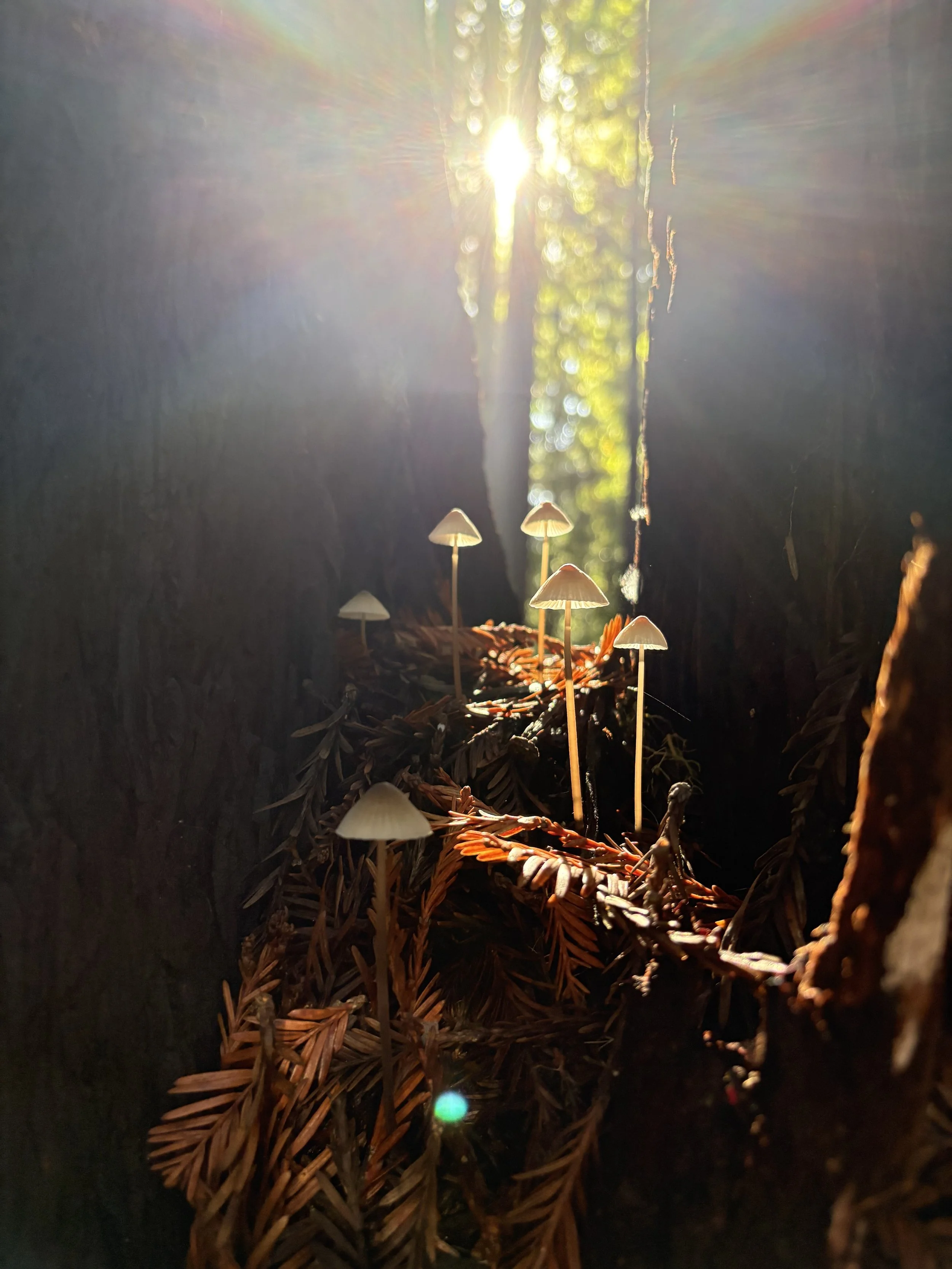
©photo my dear friend Joanna Lovera
A culmination of context and corporeal change
Have you ever walked in an old growth forest? It’s as magical as it is humbling. It rocks and creeks and rumbles, kind of like how I’d imagine an old wooden sailing ship might. It murmurs all kinds of ancient tales in an indecipherable language, as if they’re trying to ensure that the circling of hundreds if not thousands of seasons is not forgotten.
I’ve only ever stood at the foot of an ancient grove of redwoods or rested with my back against an old yew a handful of times. The same is true walking amidst etheric stands of cypress, fir, and spruce in the Pacific Northwest. There’s a different sensation than being in a park or adolescent woods. Primordial. Ease of breath. Awe. Oh to be drenched in fog with a spongy thick humus underfoot. Maybe it’s akin to what free divers experience in the ocean’s depths—sunlight filtered through multiple, dense layers or silence as the prevailing sound. Somewhere in this unfathomable landscape there’s a familiarity. And yes, it feels immense.
Which leads me to an interesting anecdote—99.9% of life on this planet is not human. Meaning the majority of animals, plants, forests, mountains, minerals, microbes, everything as it relates to atmospheric movement, seasons, snow, storms, the litany is long, all abide by a unanimously cyclical rhythm. It supports the fact that cyclical consciousness is innate. It’s of nature itself—The Mother lingua franca. It makes complete sense.
Now in contrast, cyclical consciousness or knowing isn’t absent or unfamiliar or out of sight for the remaining .01%. It’s just that many often live in adamant opposition to its rhythm and flow. It’s merely slipped away. It’s not that you and I aren’t rhythmic beings with an innate cyclical awareness. We’re all just figuring out the terribly ironic circumstances of our real nature. Somewhere along the line, what I consider to be the archetypal feminine aka cyclical consciousness was forgotten, a different story was told and we believed it, and a slow disembodiment followed. Cyclical consciousness was zapped from daily actualization. Yes, stressors and friction can amass quickly. But I’m all for a reclamation of what’s already here.
In her essay Muscle Memory, Amanda Yee (SYNONYMS issue 4 Enclaves, emphasis mine) gives tension its honest voice, facing it head on. I bring this up because I think tension is a natural, normal element of cyclical consciousness. “It was a humble reminder that tension, uncomfortable and clumsy and unresolved, is necessary for care as a practice. Not the tension that wounds but the kind that invites growth.The kind that forces us to listen longer, soften faster, and stay at the table.” There are times when avoiding the truth of opposites, like the known and unknown or what’s comfortable versus uncomfortable, can obstruct our sense of belonging.
I notice this more with aging. Perhaps it’s related to my energy taking on a tidal-like tone—a long wave of back and forth, up and down, high and low. The opposites aren’t intended to pull me apart as much as they are reminding me to hold the tension and embrace everything I already am without snapping. Cyclical consciousness. It’s also a process of slowing down and sincerely moving inward. And in doing so, I’m reviewing all that’s there. I’m facing the stubborn, insistent part of myself who pushes back. Adamant on digging in her human heels out of habit and desperation. And then there’s the part interested in retrieval and recovery. Happily flipping the narrative of aging as pathology into a tale of fruit ripening. Fruit, when allowed to fully ripen on the vine has a different taste, quality, and memory. It’s a deliciously complex culmination of context and corporeal change.
I’m like when a maiden hair fern tucks itself delicately yet deliberately on the side of a decomposing tree for shelter and sustenance or when the flower tuber remains under a thick layer of compost and mulch, only to rise stronger, larger, and more acclimatized than the season before. I’m, as John O’Donohue describes, laying low into my animal being. This is not an absence nor a series of indispensable actions. It’s an over-wintering, an act of belonging in community, a cyclical knowing. I listen to others making similar shifts in their own time and way and it excites me.
Presently, as I groove to jazz and write this essay, every cell in my body wants to free my voice and energy so that I may emerge in a courageous new way. Restore what has never really been lost—to listen quietly, to smell acutely, to observe softly, to be immense.
Yours, Erin
postscript: I want to extend all the love in my heart to the circles of amazing women in my life. While many are not physically near, you are dear. I also want to honor Claudia, Alexandra, and Sjanie for creating community and giving language to this wild, awesome, and expansive time which I now traverse. I truly feel resourced. I’m deeply grateful.