
Oceans speak
the tectonic record of a great inhale
August 30, 2026
Our food had arrived: noodles, tofu, coconut curry, rice, sauces and spice. She and I had taken him out to Thai food. We were researching the possibilities of making herbal medicinal wines; Arishta or Asava as they’re referred to in Ayurveda. He had ample experience producing them but in India, not here in the States. He had connections to ingredients, recipes, and contacts. Most importantly he had a working knowledge of the how-to gleaned from ancient texts.
Midway through the meal the conversation shifted, sideways yet adjacent. “You know, each place has a particular force, energy, and quality about it.” He continued, “the landscape we live in is alive. And, did you know that after seven years, the body becomes a part of it. Acclimatized. If we move or even travel to a different environment an internal rewiring begins to take place.” Like the Earth itself, we alter. It’s as though we begin a silent conversation with the land in order to live in harmony with it.
“Our cultures provide our tastes and preferences, but our cultures are informed, bound to our lands, said Alicia Kennedy from On Eating The Making and Unmaking of My Appetites
I’ve never forgotten that conversation. Nor how much truth ripples through me when I heard the phrase terroir of self. When it finally clicks that we’re surrounded at all times by interconnected kinship there is, without a doubt, a deep, familiar, and knowing bond that takes place. The qualities, mood, and tone of the landscape are influential and alive, not just decoration.
At times it helps if I think like a plant—a plant who was also grown from seed, rooted in a particular place, yet can also be easily transplanted at different seasons in life.
There is this philosophy woven into the fabric of Ayurveda where one can never wander too far in discussing plant medicine, food, or in this case how to make medicinal wine without coming back to the force and resonance Spirit has with place. It’s one of the most powerful relationships in our lives. And therefore commingling with a place can usher in a kind of harmonic resonance with life (capital L).
We never made the medicinal wines. In the end, licensing, tobacco regulations, distribution, and securing a continuous reliable source of raw material outweighed our desire to produce it. The recipes were tabled. The ingredient lists, contacts, procedures and processes archived. It’s all part of the research and product development process.
What has remained close (as I sip a nice rioja in my patio garden) is the powerful effect our surroundings have. Even if we’re hyper aware of it or not, paying attention or not, willing to be a little self-critical or not, context matters. Be it subtle or obvious, physiological or energetic, I’m informed by the land.
—
Framed in my dad’s home office is a large map of the world. It reveals a landscape that no one had or will ever see with their eyes. I love this map and I would stare at it whenever I was in that room. It is, literally, awesome. It’s a topographic depiction of a world without the oceans or seas. Just sheer mountain range after mountain range, cavernous ravines, snaking trenches, and mile after glorious mile of peaks freckling a vast terrescape. It’s since been replaced by a replica my mom found on Etsy. The one that hung there when I was a child eventually deteriorated. Its thin laminate eventually flaked away. The paper badly faded and torn.
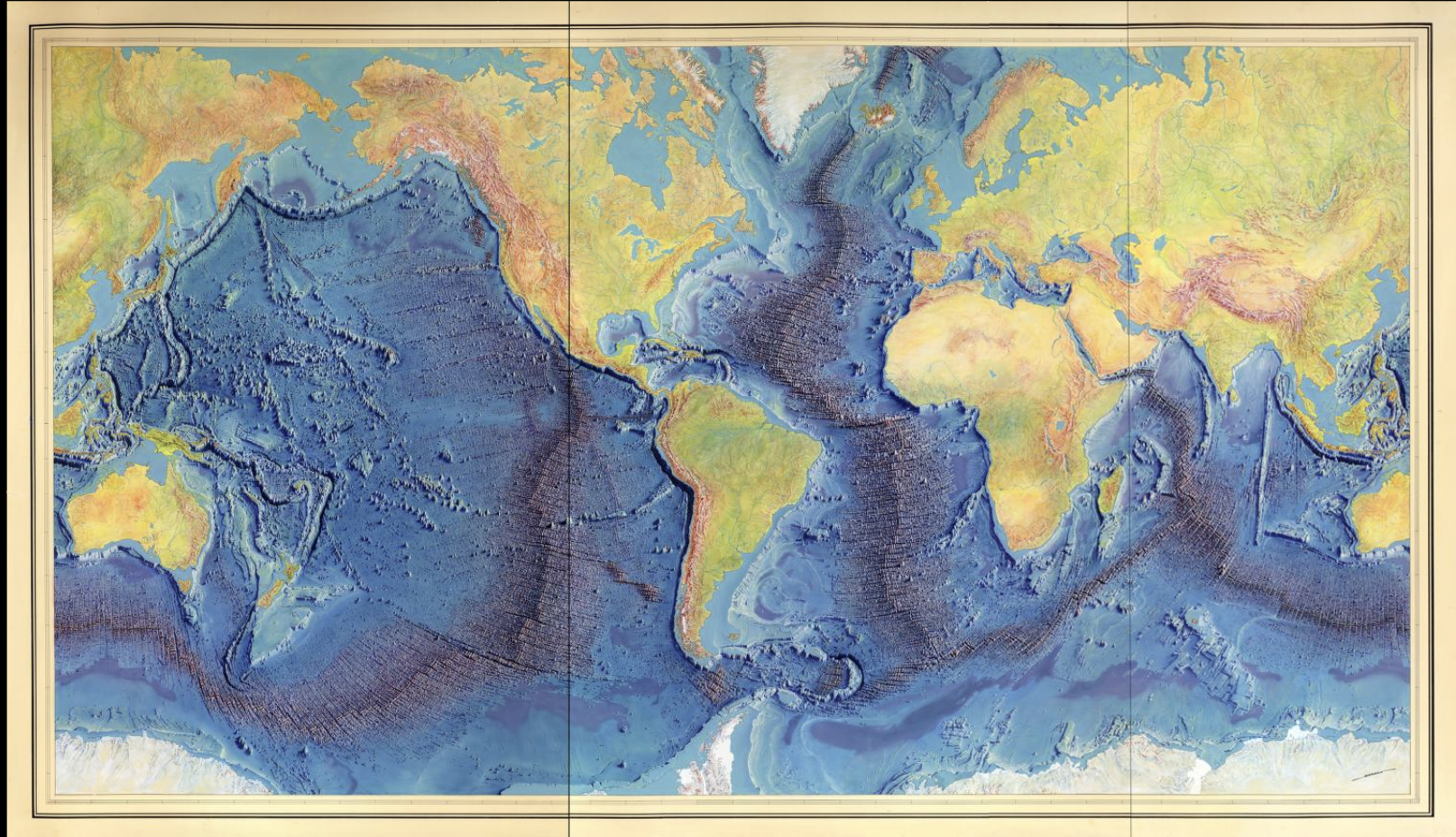
Heezan-Tharp Library of Congress
Marie Tharp, (b.1920 d.2006), trained in spherical trigonometry, is the woman responsible for this map—“the tectonic record of a great inhale splitting Earth’s solar plexus apart.”* Her ambition was anything but desultory. She decoded hundreds if not thousands of data sheets from fathometer findings making, in my opinion, one of the most captivating and extraordinary maps of all time. It not only reinforced but conceptualized that tectonic movement was the reality. And that the ocean floor was not as smooth as a bathtub.
“She has unrolled nearly a kilometer of paper stacked in the corner of her office — fathograms from soundings her boss and his graduate students have conducted on several Atlantic expeditions over the course of five years, expeditions not one of which she, any she, was permitted to join. She has spliced together a composite portrait of the ocean from the partial data sounded along the vessel’s various routes, recorded on blue linen paper with a crow quill pen and India ink. She has glued together strips of this blue linen paper into an enormous sheet sprawled across several drafting tables, magnified by a fortyfold scale of exaggeration to render the subtleties of the data legible; one of those subtleties would be the spark of revolution.”*
It’s wild to conceive of a time when the Earth was thought to be without depth, curvature, or cohesion—that it ended, sharply. History has revealed otherwise. What it’s also revealed is the possibility of discovering something that contradicts everything we consider indisputable.
Which brings me back to this glorious map. There are so many reasons why I love it, from its origin, to the comradery I feel with a woman like Marie, to the wonder it evokes. I imagine Marie in her studio surrounded by piles and piles of papers full of markers similar to that of a piano roll. Codices which on the surface simply look like a series of sequences. It reminds me how my Uncle Mac would put one of those rolls in his player piano and start pumping. Those marks gave shape to something far more magical. Coming from somewhere deep inside the belly of the piano, music would fill the room. The keys would move on their own as if played by Spirit itself. And, my god, howling above it all would be my Uncle Mac’s honest and whimsical voice; a voice with a hint of laughter, always.
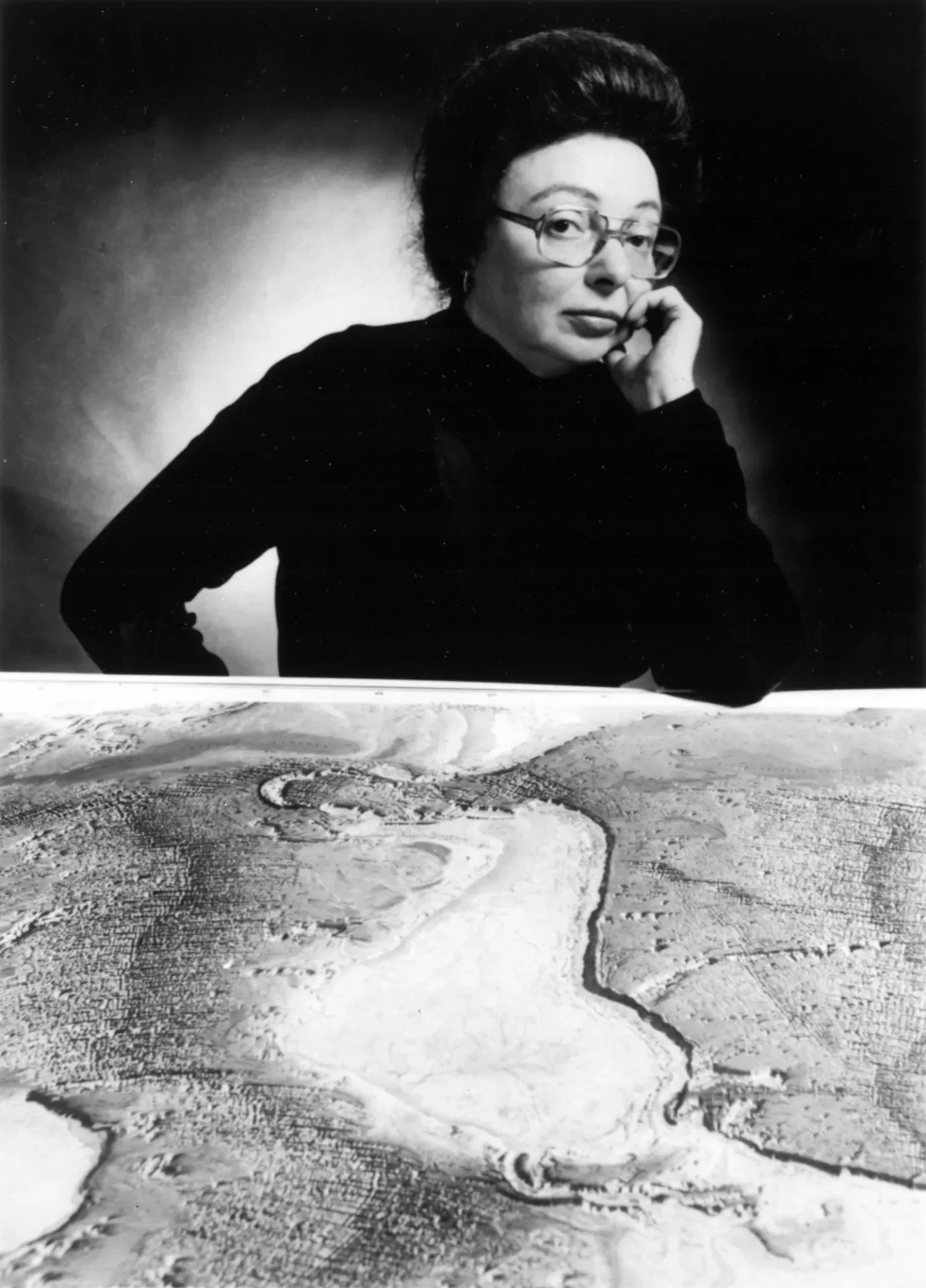
Marie Tharp
What I love most about the map is that it captures an Earth that is very, very alive with a 40,400 mile serpentine mountain range coiling like a dragon around its belly. Marie was able to transcribe a litany of dots and data into the undulating surface we now know as the oceans floor—a multi-sensorial rendering that is forever cracking, spreading, melting, sinking, and renewing itself.
I find it comforting that somewhere in the depths of absolute darkness lies a topography that’s breaking apart at the same time it's coming together, as if to be seared is not the end but a way of forming new skin. Sound like anything familiar? (You? Life?)
—
Earthbound, curious, and open, I, a mere speck on the map, stand atop a high plateau surrounded by even higher mountains, being pushed ever so incrementally higher into the sky. In this particular place I remain resonant and inextricable in relationship with the landscape, my luminous heart ready to crack apart just like Earth’s solar plexus.
Your, Erin
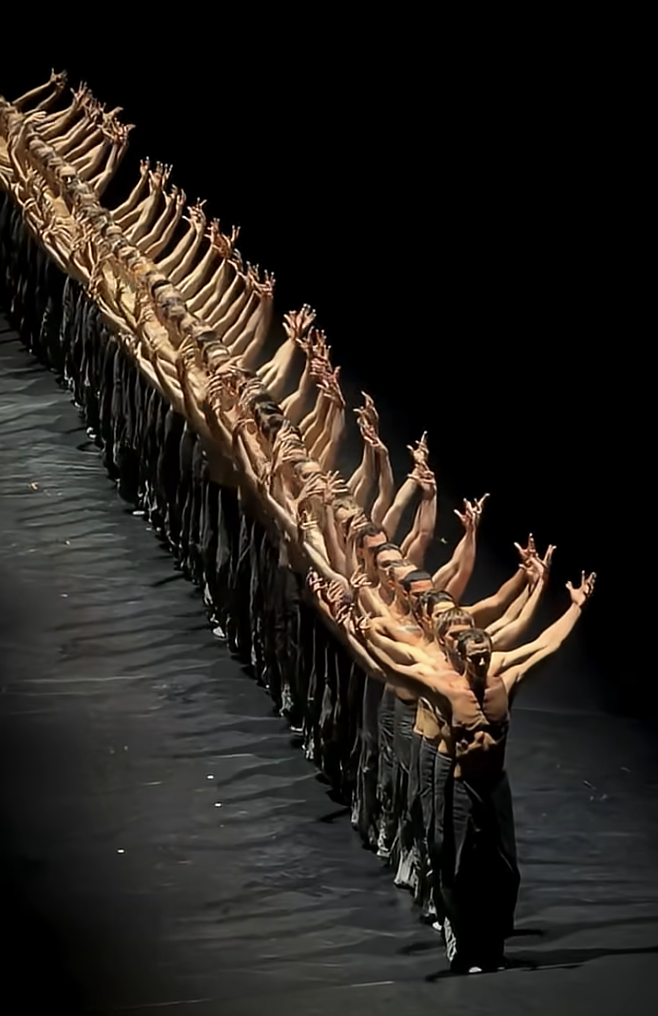
What I’m paying attention to
this clip from The Seasons’ Canon | Paris Opera Ballet reminded me of the ocean floors spreading. (image left)
NASA: seriously never a dull moment. Talk about expanding beyond the confines of the conceivable.
Elan Ullendorff’s Escape the Algorithm interview with Alicia Kennedy: “So the mechanics of the platforms and the algorithms force you to be selfish. If you start sharing other people’s work, fewer people are going to see your work. It becomes this self-perpetuating cycle of self-centeredness.”
The work of Malene Djenaba Barnett
Eskayel fabrics and wallpapers: Yes, they’re expensive but also very beautiful.
Magazines like FRIEZE: But even more specifically how I can discover new things, on my own terms, without being algorithmically spoon fed.
Currently Reading**
The HearthMath Solution by Doc Childre, Howard Martin, and Donna Beech
A Life of One’s Own by Joanna Biggs
Resources
**affiliate links
* https://www.themarginalian.org/2026/07/01/marie-tharp-traversal
https://www.loc.gov/item/2010586277/ (image reference)