
The great surrender
Writing from the field
August 16, 2026
Most summer mornings before I do much of anything, before I even make a coffee, I’ll walk into the garden. It’s both a practical and magical exercise. I check things out, assess what needs watering, breathe in the dawn, give thanks, and occasionally freak out (more on that below). It’s early in the morning where I’ve discovered that some plants like to lift up their leaves first thing, as if they too are breathing in the last of the darkness before reaching as high as they can to touch the first rays of light.
This particular morning a five foot sunflower had blown down by a mighty gust the night before. Its stalk, already two inches thick, had cracked at the base. The remedy, cut it back, chop it up, and haul it over to the compost. Right next to it, two side-by-side cucumbers I’d planted from seed had dramatically withered. Their main stems had been significantly nibbled. Soon they’d be gone.
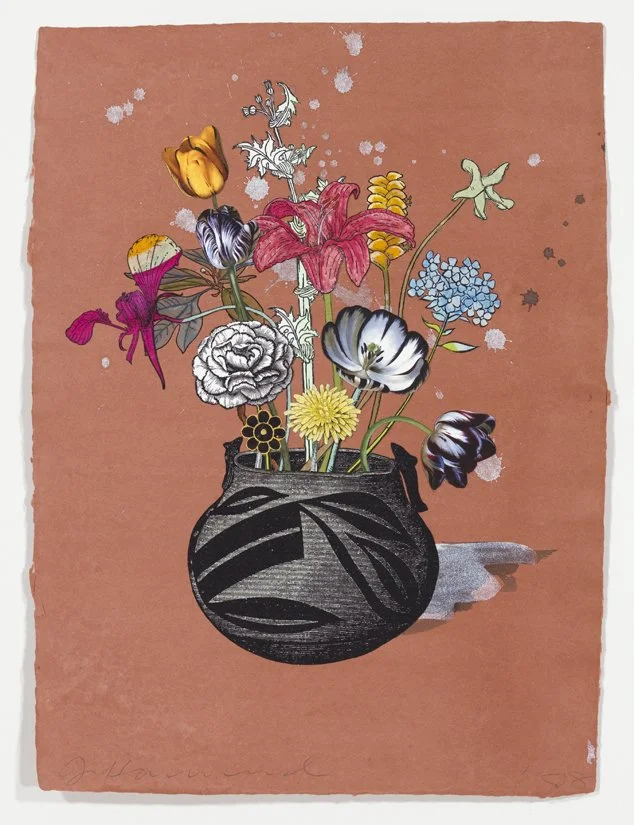
©Jane Hammond - botanical collage three
The practical magic of gardening
Changes, even alarming ones like this, can happen overnight. Hence after the ‘giving thanks’ part, there’s often an audible ‘DAMN IT! NOOOO!’ part. When this happens, and it does every season, a sense of all for naught surfaces. Any neutrality I’ve embraced quickly goes out the window. Unfortunately, there’ll be no cucumbers to harvest. I rack my brain. How did this happen? What steps can I take to remove the bugs and save the plant? Is there any chance I can push back the flood tide already in motion? (Gardening is really a form of life school.)
Literally the day before the cucumber plants were about a foot tall. They appeared happy and healthy with more leaves on the way. Maybe it was because they were so juicy that the critters came to feast. Either way, they were surrounded by a motley crew of ants, sowbugs, and the bane of any New Mexican farmer, the notorious squash bug, specifically the tiny teenager stage.
Side note: I will say that the Southwest has been a tinderbox. And I think this factors in. For the first time in the twenty three years I’ve lived here the lazy Rio Grande which flows through the city has run dry. Water is scarce. The weather is extreme. Animals, myself included, are supplementing in different ways. Under the current circumstances, these plants fulfilled a different role.
I read once that if there aren’t bugs, insects, or other creepy crawlers en masse in the garden something’s probably wrong. They’re essential to a dynamic and functioning ecosystem. Pathways are circuitous. Populations naturally rise and fall. And yes, sometimes things can swing out of balance to the point where there’s an undesirable proliferation of sowbugs. What I’m presently dealing with. Nature’s never squeaky clean. When I want that, I stick to mopping the kitchen floor; an activity I can easily control with results I can predict.
What has come out of balance, and how do I return?
Nevertheless what followed was an internal litany. Is it the layers of straw and organic matter that’s supporting their cause? (This is what I suspect and changes will be made). Is the bedding down method I employed over the winter coming to bite me in the ass? Did the chop and drop method go awry? There’s always so many questions. With answers still forthcoming. I’m even considering personally emailing António Coelho from Terra Sintrópica to fully understand their process.
In my twenties I discovered things like the Findhorn Garden project and Rudolf Stiener’s teachings on agriculture both of which were revelatory. I felt it in my bones that life encompassed all that was seen and unseen, including life in the garden, but they reaffirmed it. The landscape is a communal haven shared by an inter-web of insects, bugs, spirits, fairies, devic beings, humans, plants…..and so on.
Ever since, these teachings have informed my approach, a more hands off form of stewardship. What has become steadfast is building the health and vibrancy of soil ecology through natural amending, cover crop rotations, compost building, and periods of rest. Right now, however, it’s triage. Something is off. As pesticides or chemical-based solutions aren’t an option I’m dusting selected seedlings with neem powder (not really working) and likely going to scrape away the layers of straw and other debris for proper composting. If you have any experience with this, I’m all ears.
Trust me, the garden says, I’ve got this.
When the variables are constantly changing I tend to improvise with the wisdom and resources available in my toolkit. I do all I can do, and in many cases start over. I have no secret ingredient aside from course corrections, albeit nuanced or familiar. Time will tell. Life can spark into existence just as quickly as it can be extinguished. Neither is more precious than the other.
Still, my heart breaks. I know these prehistoric crustaceans are just doing what they do: ravenously consuming both living and decomposing matter. I squat down to inspect the plants, take a generous breath, and consider the line from T.S. Eliot. “We die with the dying. See, they depart, and we go with them. We are born with the dead. See, they return, and bring us with them.” Oh death, great giver of life, I’m already holding your hand. May all that’s constricting my heart break away so that it can expand.
That same day the sunflower and cucumbers met their demise I spotted a volunteer cucumber in an entirely different part of the garden. Informed by an invisible intelligence and imbued with a special resiliency only volunteers seem to have, it appeared unscathed. Coincidentally it’s not surrounded by straw or layers of last season's decomposition. Rather it’s sheltered by an arc of flowers, amaranth and cosmos. Befriending a garden is a great surrender, an empirical study of trial-and-error and adaptation. It’s both generous and unbridled, a humble exploration of balance, flow in contrast to fixity. After twenty seven years, I’m still working out the details. Studying it. Trusting in it. Adjusting to what arises year over year. I suppose the experiment will conclude if and when I walk away. Today is not the day.
Yours, Erin
NEED TO TALK ABOUT YOUR GARDEN?
If you made it this far and are interested in all things cucumbers-plus the art, craft, and craze of gardening and need help—let's talk. I may not know everything, thankfully, but I know plenty.