
On being influenced
when it’s actually about selling perfume or luggage food becomes an afterthought
September 13, 2026
I don’t write ‘critique’. Nor do I identify as a food writer. If and when I write about food it’s because I write about life, ecology, and well-being. And I don’t consider them separate. It’s all an interdependent web. We exist in and with each other.
However, the following is my version of an opinion piece on a topic I find a little bizarre: tablescape influencers. At this point your eyebrows may be furrowed into an understandable, what…tablescapes...selling perfume? I know. My sentiments exactly.
What sparked it all was the article by Timi Sotire titled The Rise of Tablescaping Influencers published via VITTLES. The essay dives into the fascinating, not so discreet task of tablescaping or in layman's terms, setting the table. But in this case the person setting it happens to have been bestowed the title of ‘Influencer’. It’s worth noting that this is a lofty, socially prescribed title for someone who wields the power (or at least thinks they do) to sway, in a sense bewitch, their audiences into buying a slice of fabricated fantasy.
I’ve linked the digital article but you can also read it in their print issue, ‘The Influencers’, which is all about how the internet and short-form video have reshaped food culture, as well as about the broader sociocultural systems and structures that shape how we eat today.
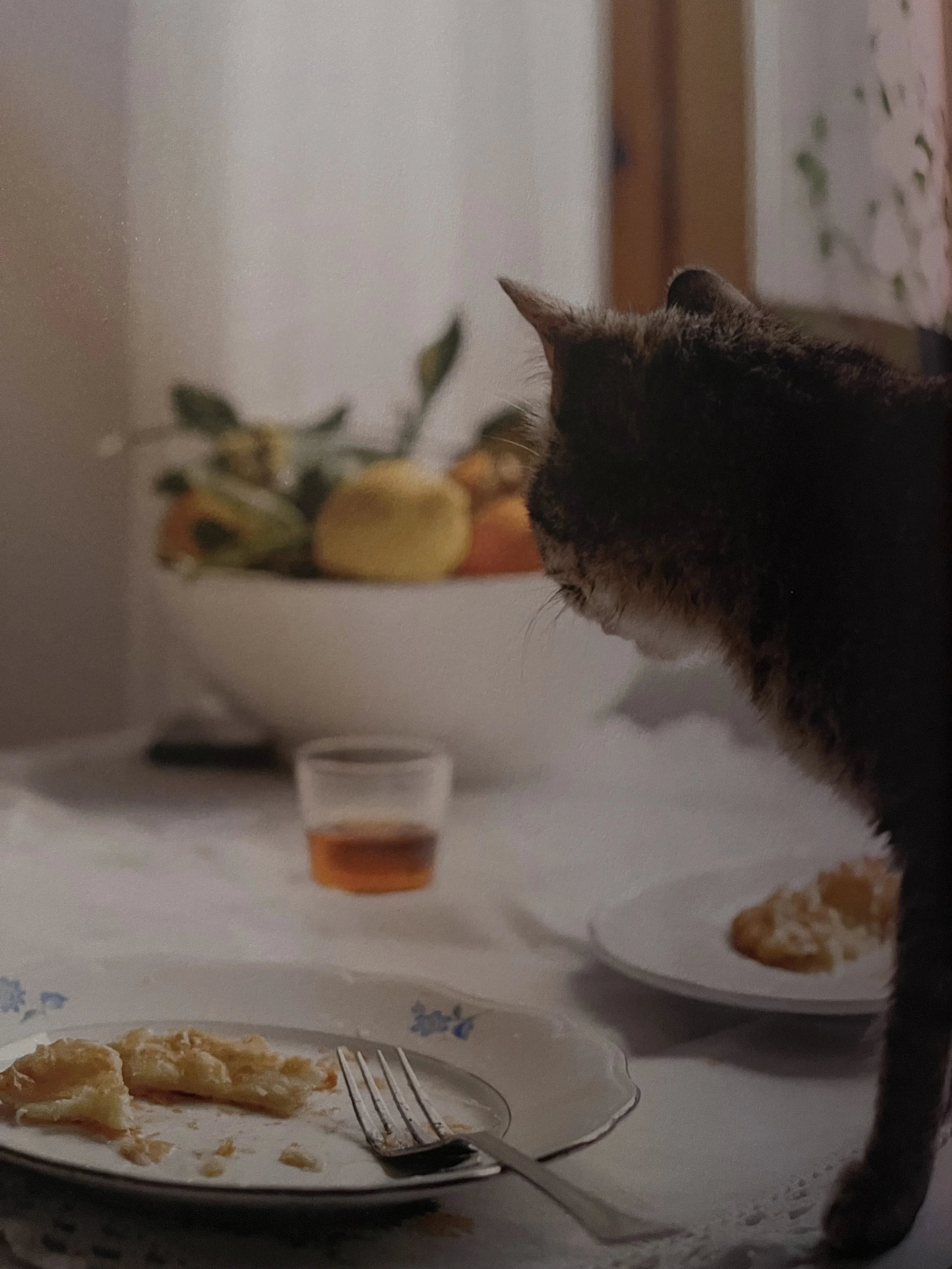
©matt russell from Letitia Clark's Bitter Honey
Now seeing how I have a publication called The Center Piece, (a cheeky play on words alluding both to the invisible force of nature which binds us together and an object placed at the hub around which we dine) I have some notes. First, I want to begin by honoring that there’s nothing new about adorning a table or the place where people share conviviality. Historically, across culture and class, the place where folks gather, sit, and eat has always been demarcated in some way or form. A cloth is laid upon the earth. Chairs set around a table. A candle lit. Platters filled and set at the family’s center. A central fire upon which a pot suspends.
What is new in the setting-the-table phenomena (I’m only lukewarm to the term tablescaping) is the extent to which it’s become grossly commodified, over-the-top with a general air of opulence, and overtly suspect of third-party endorsement.
Admittedly there’s nuances that range from the grandiose banquet to a simple Wednesday dinner to everything in between. Yet regardless, a through line exists. We gather to talk, to share, to curb hunger, and to be with others. Frankly the cases that are shared in The Rise of Tablescaping Influencers encapsulates everything I find distasteful about the Influencer business model and its adjacent marketing formula.
—
My skin bristles when I see this happening. Good food, friends, family, and meaningful conversation are the qualitative pillars that I associate with a good time and an enriched life. They shouldn’t be, as one commentator noted, an afterthought. Exhausted by this example of monetization and advertising, it only reinforces a growing distance between any sort of graciousness and the next meal. I assume businesses profit and personal empires balloon or else they would stop being so damn enthusiastic about table setting or hosting or, and I quote, ‘inconveniencing myself to bake a coconut & raspberry layer cake for my best friends birthday’ whilst in reality, said Influencer, is actually just trying to sell perfume, luggage, or handbags. Ick. I’d hope that baking your friend a cake wouldn’t be an inconvenience.
Perhaps it all harkens back to my dislike of being talked at rather than genuinely listened to. In the realm of tablescaping influencers the point isn't the swirl of conversation. Rather it's capturing an image: the one-sided, two dimensional and of a particular campy, glitz, glam, gaudy, maximalist, minimalist, farmhouse boho aesthetic.
It’s a tricky and dangerous zone when the table is given carte blanche. It becomes a symbol for the perfect party. When in reality it is layer after unrealistic layer of stuff obscuring the actual feast. At it's worst, a psychosis illuminated with enough candles you’d think you’re attending a vigil. It’s as if the menu cards should read: for spectators only. If you’re wanting a good meal, look elsewhere.
One reader, and I paraphrase, shared her perspective as a restaurateur. She signed off by reiterating the incomparable value of good food compared to fancy place settings, even if they are interesting, they don’t stand a chance against food that is genuinely delicious. That’s what lingers, not the bouquet that’s blocking one’s view. A tablescape can be read as generosity yet it’s in fact the cheapest part of hosting. The food costs money every single service and a table setting costs money once. Anyone who has had to fill a room knows which of the two the guests actually remember.
—
I wouldn’t say I was enraged but the further along I read the more annoyed and disheartened I became regarding the vanity and veneer that seems to perpetually ooze from a visually handicapped pop culture. Food, family, friends become an afterthought. An image or idea boils down to an aesthetic void of people but filled with flashy place mats and glassware.
I’ve been told that this makes it easier for the viewer to picture themselves in the mix. Does it though? Sitting down together and enjoying good food, drink, and story needn’t be an insurmountable hurdle. Yet I find it disagreeable when the media confines it to ‘look’ a certain way. And when that look becomes contagious.
You can find a similar zeal in interiors. Perhaps you’ve seen it, the perfectly styled home is simultaneously vacant and lifeless. I’m ready for images that reflect a reality where there’s an inviting space to plop down and share in a cup of tea and a slice of pie. Please, one approachable chair and a dish strewn kitchen after family dinner.
What I’ve come to is this: if the way a table is dressed makes you feel more welcome, more at ease? Great. If it doesn’t, then what does? How is it that you share your humanity with others? When is eating really enjoyable? For me no amount of decor is going to make up for simply getting together. Heart and hospitality need not have candelabras or menu cards. It can be fun but not necessary. A cake extravagantly coiffed with frosting is eye-catching but is commonly the first thing I shave down in order to enjoy what’s underneath. Same goes for a really good DJ. It doesn’t matter where I’m dancing. The music ignites something on the inside.
In the end, I’d be lying if I said, I’ve never been influenced. (I bought the lip gloss. I love the lip gloss.) Other people, things, ideas, you name it are interesting and inspiring and influential. I continue to be curious about contribution yet cautious about fear messaging. Yes, I prefer a cloth napkin, a nicely weighted fork, and a well designed spoon that fits comfortably in my hand. I rarely set the table aside from a table cloth, plates, napkins, spoons, and fresh flowers. And that’s if I happen to have any in the garden to pick. Most nights we’re at the kitchen counter or we plop down in one of our cozy chairs. Let’s just say at this point in the game I’m clear about my priorities.
Yours, Erin
p.s. I had to include this snippet from FOR SCALE — a no nonsense publication celebrating the supreme potential of domestic space, written by David Michon, past contributor to ACNE PAPER, PIN-UP, L’UOMO VOGUE, MONOCLE. It speaks volumes.
We repeat other people.
It’s a problem in tourism, so it becomes a problem in “REFERENCES” and trickles down into the mood-boardery Pinter*stery people’s current life choices and ergo also décor. Don’t think these things aren’t connected.
One should not just be “SEEING THINGS FOR ONESELF” (i.e. because they have been seen first on the Instagr*m of others, and now u want it too), but in fact we should be putting ourselves in the position to be surprised a thing existed. This prompts: QUESTIONS, BRAIN ACTIVITY, EXPANSION.
Again, so rarely do we feel like freaks. To develop INDEPENDENT AND PERSONAL TASTE, we must feel more comfortable feeling like little freaks.